Introduction
Your customers no longer browse online stores with the same expectations they had just a few years ago. They want confidence before clicking the Buy Now button. They want to see how a ring fits on their hand, how a pair of glasses complements their face, or how a sofa looks in their living room without visiting a physical store.
Virtual try-on technology is quickly becoming a competitive advantage for brands that want to deliver that experience. Industry research continues to show that immersive shopping experiences can increase engagement, improve purchase confidence, and lower return rates across multiple product categories.
However, there is another side to the story.
Many retail leaders discover that implementing virtual try-on involves technical complexity, operational planning, and organizational commitment that are rarely discussed in sales presentations. Camera permissions, device compatibility, AI accuracy, asset creation, and platform integration all influence whether a deployment succeeds or struggles.
Understanding these challenges does not weaken the business case. It strengthens it.
When you prepare for implementation with realistic expectations and the right partners, virtual try-on becomes a long-term investment that supports revenue growth instead of another experimental technology project.
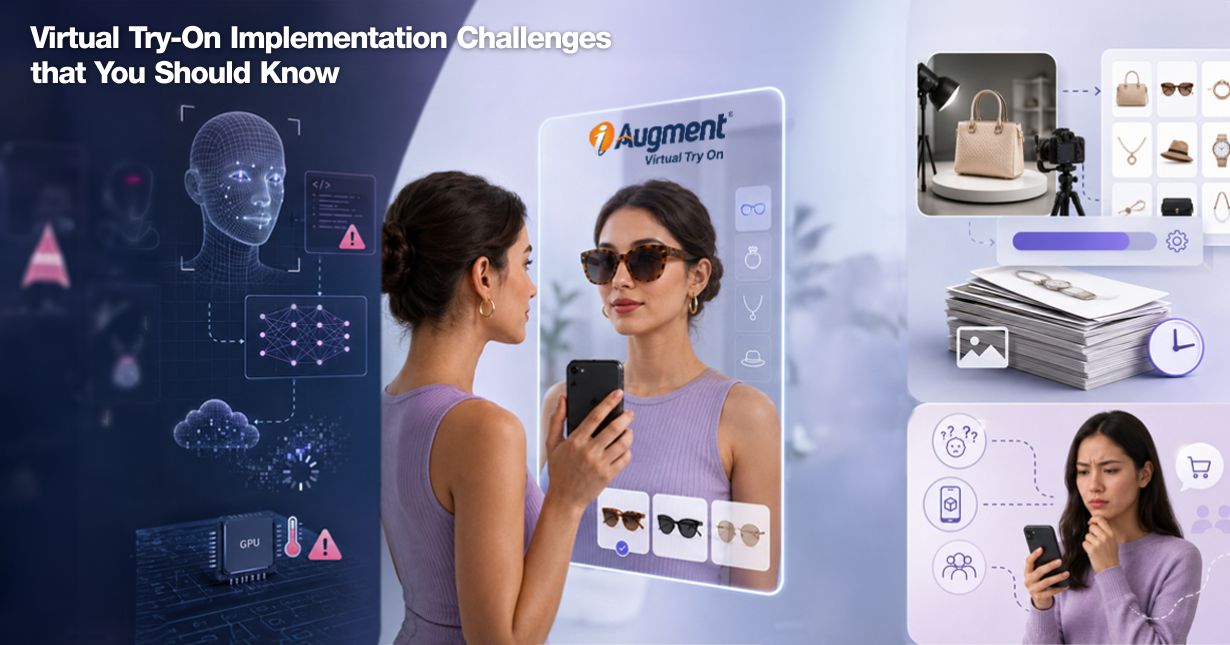
The Strategic Value of AR in Modern Retail
Virtual shopping is evolving from static product pages into interactive experiences that help customers make informed buying decisions.
Instead of imagining how a product might look, shoppers can visualize it on themselves or within their environment. This additional confidence often translates into measurable business outcomes.
Know the top benefits of virtual showroom.
Retail brands are increasingly investing in augmented reality retail because it addresses several critical performance metrics simultaneously.

1. Higher Conversion Rates
One of the biggest challenges in eCommerce is purchase hesitation.
Customers hesitate because product images cannot answer questions about size, appearance, or compatibility. Interactive visualization reduces uncertainty and gives shoppers another reason to complete their purchase.
Brands that implement high-quality virtual try-on software frequently report longer session durations and stronger engagement compared to traditional product galleries.

2. Lower Return Costs
Returns remain one of the most expensive operational problems in online retail.
Every returned product generates reverse logistics costs, inventory processing expenses, customer service interactions, and lost revenue opportunities.
When customers have a better understanding of how products will look or fit before purchasing, they are more likely to keep what they order.
3. Better Customer Engagement
Interactive experiences naturally encourage exploration.
Customers spend more time comparing products, testing colors, viewing different angles, and experimenting with personalization options.
Learn ho virtual showroom can help generate quality leads.
This additional engagement provides valuable behavioral insights that can improve merchandising strategies and future marketing campaigns.

4. Competitive Differentiation
Consumers increasingly associate immersive shopping experiences with innovation and premium service. Brands that successfully combine excellent products with intelligent digital experiences create stronger differentiation in crowded markets.
For this reason, many retail executives now view eCommerce AR integration as a strategic business initiative rather than a marketing experiment.
Hidden Challenges in Virtual Try-On Implementation
Despite the significant business value, virtual try-on implementation presents genuine technical and operational obstacles.
Success depends on planning for these challenges before deployment instead of reacting after launch.
The most common implementation issues fall into three categories:
- Technical limitations
- Digital catalog preparation
- Customer adoption and user experience
Understanding each area allows your organization to allocate budgets, timelines, and internal resources more effectively.
Study how you can visual commerce as conversion optimization strategy.

3.1 Technical Hurdles and AI Constraints
Lorem ipsum dolor sit amet, consectetur adipiscing elit. Ut elit tellus, luctus nec ullamcorper mattis, pulvinar dapibus leo.
3.1.1 Precision Fit and Real-Time Physics
Customers immediately notice inaccuracies.
If a necklace floats above the skin, a watch is slightly off on the wrist; the customer’s confidence disappears.
High-performing virtual try-on software depends on several technologies working together:
- AI body and face detection
- Depth estimation
- Real-time rendering
- Lighting correction
Jewelry retailers encounter another challenge. Ring sizing must account for finger shape, camera angle, perspective distortion, and hand movement while maintaining realistic scaling.
Lighting introduces another layer of complexity.
Metal surfaces reflect ambient light differently than gemstones or fabric textures. If digital rendering fails to match real-world conditions, customers may perceive products as inaccurate.
The solution is continuous AI model training combined with extensive testing across multiple environments rather than relying solely on laboratory conditions.
3.1.2 Device Performance and Processing Power
Not every customer owns the latest smartphone.
Many shoppers use older devices with limited processing capabilities or slower internet connections.
Heavy rendering can create:
- Slow loading times
- Reduced frame rates
- Battery consumption
- Application crashes
Each of these problems increases abandonment risk.
Successful retailers optimize asset sizes while balancing image quality and rendering performance.
Cloud rendering, adaptive resolution, progressive loading, and compressed models help deliver consistent experiences across diverse hardware configurations.
These optimizations become particularly important when brands expand internationally or target broad consumer demographics.
Understand the importance of visual commerce for SMEs.
3.1.3 Tech Stack and API Compatibility
Virtual try-on cannot operate in isolation.
It must connect with product catalogs, inventory systems, analytics platforms, customer data, and checkout experiences.
For many retailers, this means integrating with:
- Shopify Plus
- Salesforce Commerce Cloud
- Adobe Commerce
- Headless commerce architectures
- Custom enterprise platforms
Without proper planning, integration projects become expensive and time-consuming.
API inconsistencies, authentication conflicts, data synchronization issues, and legacy infrastructure can delay deployment schedules.
One of the most common questions technology leaders ask is the best tech stack for AR virtual try-on.
The answer depends on existing architecture rather than selecting the newest platform.
An effective implementation combines scalable cloud infrastructure, reliable computer vision APIs, optimized rendering engines, analytics capabilities, and flexible middleware that supports future expansion.
Choosing technology that complements your existing ecosystem reduces migration costs and simplifies long-term maintenance.
Another important planning exercise involves understanding how to reduce virtual try-on drop off rates before development begins.
Many brands focus exclusively on rendering quality while overlooking onboarding friction, camera permissions, and loading performance that significantly influence customer adoption.
Preparing for these factors during architecture planning creates a much stronger foundation for launch.
Discover virtual showroom marketing.
3.2 The Catalog Digitization Bottleneck
A virtual try-on experience is only as good as the digital assets behind it.
Many retailers underestimate this stage because they assume existing product photography can simply be converted into interactive models. In reality, building a scalable digital catalog requires significant planning, investment, and quality control.
If your catalog contains hundreds or thousands of SKUs, digitization often becomes the longest phase of the entire project.
3.2.1 The High Cost of 3D Asset Creation
Traditional product photography captures a product from a few angles.
Virtual try-on requires a fully interactive representation that can rotate, respond to movement, and react to lighting conditions in real time.
This is where 2D asset creation becomes a major business consideration.
Each product may require:
- High-resolution images
- Precise cutting and polishing images.
- Texture mapping
- Material rendering
- AI-optimization
- Quality validation
The cost varies depending on product complexity.
Simple accessories can be converted relatively quickly, while luxury jewelry, and watches often demand far more detailed modeling.
Many enterprise retailers reduce costs by prioritizing best-selling collections instead of digitizing every SKU at once.
This phased approach allows teams to measure performance improvements before expanding across the complete inventory.
Another effective strategy combines manual modeling with AI-assisted 2D asset creation, reducing production time while maintaining visual quality.
Practical Solution
Rather than attempting a full catalog conversion immediately, organize products into three categories:
- High-volume sellers
- Seasonal collections
- Long-tail inventory
Launching with high-performing products delivers measurable business results faster and provides valuable implementation insights.
3.2.2 Scaling Your Digital Inventory
Creating a few hundred assets is manageable.
Scaling to thousands introduces a completely different operational challenge.
Large retailers frequently struggle with:
- Inconsistent model quality
- Multiple design agencies
- Version control
- Product updates
- Color variations
- Metadata management
Every catalog update creates additional work.
If a product receives a new finish, material, or design revision, the corresponding digital model also requires updates.
This is why successful organizations establish standardized asset governance from the beginning.
A centralized asset library, documented modeling standards, and automated validation processes help maintain consistency across large product portfolios.
Learn why digital showrooms are essential for B2B and B2C product demonstration.
Retailers that integrate virtual try-on software directly into their product information management systems can also simplify updates and reduce manual effort.
As adoption grows, scalable asset management becomes just as important as technology itself.

3.3 User Experience Hurdles and Adoption Friction
Even the most advanced technology fails if customers decide not to use it.
Many retailers invest heavily in development but overlook the psychological factors that influence adoption.
The objective is not simply building an AR feature. The objective is creating an experience that customers trust and enjoy using.
3.3.1 Overcoming High Abandonment Rates
One of the biggest obstacles appears before customers even begin the experience. Camera permission requests create hesitation. Many users worry about privacy, data storage, or unnecessary app permissions.
Others simply leave the page instead of responding to a permission request.
This behavior creates significant abandonment during the first few seconds of interaction.
If you are evaluating how to reduce virtual try-on drop off rates, the answer extends beyond technical optimization.
Successful brands improve adoption by:
- Clearly explaining why camera access is required
- Displaying privacy information before permission requests
- Offering image upload alternatives
- Reducing loading times
- Providing guided onboarding
Simple instructions and transparent communication often improve participation more than additional technical features.
Retailers should continuously analyze funnel data to identify where users exit the experience and refine those stages through testing.
Learn how virtual try-on strengthen customer purchase decision.
3.3.2 Building Consumer Trust in Digital Accuracy
Trust determines whether customers complete a purchase. If shoppers believe a product appears larger, brighter, or different from reality, confidence disappears immediately.
This challenge affects every product category. Jewelry buyers question gemstone size.
The most successful implementations openly communicate expected accuracy while supporting visualization with additional product details.
Brands should combine virtual try-on software with:
- Multiple product images
- Size guides
- Customer reviews
- Lifestyle photography
- Product videos
This layered approach creates stronger purchase confidence than relying on AR alone.
Retailers also improve trust by continuously calibrating AI models using customer feedback and real usage data.
3.3.3 Solving the Sensory Deficit
Digital shopping still cannot fully replace physical interaction. Customers cannot test product weight. They cannot experience the design through a screen.
This sensory limitation remains one of the biggest challenges in augmented reality retail.
Leading brands compensate by providing richer digital information.
High-resolution zoom features, interactive product demonstrations, close-up texture visualization, and user-generated content help customers build confidence before purchasing.
Some retailers also combine AR with virtual consultations and live shopping sessions, allowing experts to answer questions in real time.
The objective is not replacing physical retail. It is reducing uncertainty enough for customers to make informed buying decisions.
Learn how virtual try-on enhance product discovery and boost AOV.
Framework for a Successful Rollout
Technology projects succeed when planning comes before implementation.
Instead of launching across every product category at once, build a structured roadmap that minimizes risk and generates measurable business insights.
Step 1: Audit Your Existing Infrastructure
Begin with a complete assessment of your current commerce ecosystem.
Review:
- Commerce platform
- Mobile performance
- Product information management
- Digital asset management
- Analytics capabilities
- API readiness
This audit identifies integration gaps before development begins.
Step 2: Define Business Objectives
Technology should support measurable outcomes.
Establish clear KPIs such as:
- Conversion rate improvement
- Return rate reduction
- Customer engagement
- Average order value
- Session duration
Clear objectives help leadership evaluate project success beyond technology adoption.
Understand how to implement AI-guided selling in virtual showrooms.
Step 3: Choose the Right Technology Partner
Many vendors provide impressive demonstrations. Fewer provide long-term implementation support.
Look for partners with experience in:
- Enterprise retail deployments
- eCommerce AR integration
- AI optimization
- Security compliance
- Performance monitoring
- Scalable cloud infrastructure
A collaborative implementation partner often contributes more value than selecting the lowest-cost provider. Many technology leaders also ask about the best tech stack for AR virtual try-on during vendor evaluation.
Instead of chasing trends, prioritize compatibility, scalability, documentation quality, analytics support, and long-term maintenance capabilities.
Step 4: Launch a Pilot Program
Start with a focused deployment.
Select one category, measure performance, gather customer feedback, and refine the experience before expanding. Pilot programs reduce implementation risk while generating executive confidence through real business data.
This phased strategy allows teams to validate assumptions before investing in full-scale deployment.
Study how iAugment virtual try-on bring jewelry to life.
Why the Investment Is Worth the Friction
Every transformative technology introduces a learning curve.
Cloud commerce requires infrastructure changes. Mobile commerce requires responsive design and app development. Artificial intelligence now requires quality data and thoughtful implementation.
Virtual try-on follows the same pattern.
The initial investment may involve platform integration, staff training, asset production, and testing, but the long-term business value often outweighs those early challenges.
Improved Conversion Performance
Customers who can confidently visualize products are more likely to complete a purchase.
Instead of relying solely on product descriptions or static images, they interact with products in a way that feels more personal and informative.
This confidence reduces hesitation and helps move shoppers from consideration to checkout.
Lower Return and Operational Costs
Returns affect profitability far beyond shipping expenses. Every returned item requires inspection, repackaging, inventory updates, customer support, and additional logistics.
A well-executed virtual try-on experience helps customers make better purchase decisions before placing an order, reducing avoidable returns and improving operational efficiency.
Understand phygital solution in retail.
Increased Customer Loyalty
Consumers remember brands that make shopping easier. When customers consistently receive products that match their expectations, they are more likely to return for future purchases and recommend the brand to others.
Interactive experiences also encourage longer browsing sessions and deeper engagement with product collections, strengthening customer relationships over time.
Better First-Party Data and Business Insights
Every virtual interaction provides valuable information.
Retailers can analyze:
- Most tried products
- Popular colors and styles
- Customer preferences
- Session duration
- Purchase patterns
These insights support merchandising decisions, inventory planning, and marketing campaigns while helping businesses better understand customer behavior.
Future-Ready Commerce
Consumer expectations continue to evolve. Today’s shoppers expect personalized, immersive experiences across every digital channel.
Brands that invest in augmented reality retail today are building capabilities that will support future innovations in spatial commerce, AI-powered shopping assistants, and connected retail experiences.
Rather than reacting to changing expectations, you position your organization to lead the market.
Discover which one is better: CX vs UX.
Competitive Advantage That Compounds Over Time
Technology itself is no longer the differentiator.
Execution is.
Brands that successfully combine high-quality products, intelligent eCommerce AR integration, and exceptional customer experiences create advantages that competitors cannot easily replicate.
Every optimization, customer interaction, and product insight contributes to a stronger digital ecosystem that becomes more valuable over time.
Conclusion
Virtual try-on is no longer a novelty reserved for global enterprise brands. It has become a strategic capability that helps retailers improve customer confidence, increase conversions, and reduce costly returns.
The implementation journey is not without challenges.
Technical limitations, catalog digitization, AI accuracy, and customer adoption all require careful planning and cross-functional collaboration. A realistic roadmap and the right technology partner make these obstacles manageable and significantly improve the likelihood of success.
The brands that gain the most value are not those that launch the fastest.
They are the ones that build a scalable foundation, start with measurable objectives, learn from pilot programs, and continuously refine customer experience. Now is the right time to evaluate your readiness.
Audit your current infrastructure, identify the product categories that would benefit most from immersive shopping, and build a phased implementation plan that aligns with your business goals.
The investment may introduce short-term complexity, but the long-term rewards include stronger customer loyalty, healthier margins, richer business insights, and a more competitive position in an increasingly digital retail landscape.
Frequently Asked Questions
Q. What is the average cost of implementing virtual try-on software?
The cost of implementing virtual try-on software depends on the complexity of the solution, the size of your product catalog, and the level of customization required.
Small pilot projects may cost a few thousand dollars, while enterprise deployments with advanced AI capabilities, custom integrations, and extensive catalogs can require investments ranging from tens of thousands to several hundred thousand dollars.
Many retailers begin with a limited rollout to validate ROI before expanding across additional product categories.
Q. How long does it takes to convert a retail catalog into 2D assets?
The timeline depends on catalog size, product complexity, and the production workflow. A small collection can often be digitized within a few weeks, while large retailers with thousands of SKUs may require several months for complete 2D asset creation.
Many organizations prioritize high-performing products first and gradually expand their digital inventory, allowing them to launch faster while maintaining consistent asset quality.
Q. Do customers actually prefer online shopping with augmented reality?
Yes. Customers increasingly appreciate interactive shopping experiences because they provide greater confidence before making a purchase. High-quality augmented reality retail experiences help shoppers visualize products more accurately, compare options more effectively, and make informed decisions without visiting a physical store.
When the technology is fast, intuitive, and realistic, it often leads to higher engagement, improved conversion rates, and stronger customer satisfaction.
Q. Can virtual try-on technology integrate with exiting eCommerce platforms?
Yes. Most modern virtual try-on software solutions integrate with platforms like Shopify, Adobe Commerce, Salesforce Commerce Cloud, WooCommerce, Magento, and custom headless architectures through APIs and SDKs.
Choosing a compatible solution helps brands launch faster while maintaining a consistent shopping experience.
Q. Which industries benefits the most from virtual try-on technology?
Fashion, eyewear, jewelry, beauty, footwear, furniture, and home décor brands see the greatest value from virtual try-on experiences. Any business that wants to increase customer confidence, reduce returns, and improve engagement can benefit from augmented reality retail solutions.