Online shopping has evolved far beyond product listings and static images. Today’s customers expect digital experiences that feel interactive, personalized, and confidence driven.
This sift is one of the biggest reasons why virtual try-on technology has moved from being an innovative feature to becoming an essential part of modern eCommerce.
From beauty and eyewear to jewelry and fashion, consumers now want to see how products look on them before making a purchase. They expect realistic product visualization, instant personalization, and seamless mobile shopping experiences.
For eCommerce brands, virtual try-on is no longer just a conversion tool. It has become a critical customer expectation that directly impacts engagement, trust, product returns, and buying decisions.
As AI-powered commerce and immersive shopping continue to grow, brands that fail to offer interactive experiences risk losing relevance in an increasingly competitive market.
Know how to choose the right 3D development company in India.
The Evolution of eCommerce Customer Expectations
The modern online shopper behaves very differently from customers a decade ago. Earlier, consumers were willing to rely on product descriptions, size charts, and a few static images. Today, that approach no longer feels sufficient.
Customers now expect experiences that reduce uncertainty and replicate the confidence of in-store shopping. This transformation is largely driven by mobile commerce, social media influence, and rapid advancements in AI and augmented reality technologies.
Consumers spend hours interacting with visual content on platforms like Instagram, TikTok, and Pinterest. This visual-first behavior has naturally extended into eCommerce. Shoppers want experiences that are immersive, interactive, and personalized to their preferences.
This is where virtual try-on in eCommerce becomes highly valuable.
Instead of imagining how a product may look, users can instantly visualize it on themselves in real time. Whether it is trying on glasses, testing lipstick shades, previewing jewelry, or visualizing sneakers, virtual try-on technology creates a stronger emotional connection between customers and products.
Learn how stacking increases average order value for jewelry.
What Is Virtual Try-On Technology?
Virtual try-on technology allows online shoppers to digitally visualize products on themselves using augmented reality, artificial intelligence, and rewl-time rendering technologies.
Depending on the industry, virtual try-on solutions may use:
- Facial recognition
- Body tracking
- 2D product rending
- AI-based product mapping
- Smartphone camera integration
- Real-time AR overlays
Unlike static product photography, virtual try-on solutions create interactive shopping experiences that help customers make faster and more confident purchasing decisions.
Industries actively using AI virtual try-on technology include:
- Jewelry eCommerce
- Eyewear brands
- Beauty and cosmetics
- Fashion retail
- Footwear
- Watches and accessories
The rise of AR shopping experiences has fundamentally changed how consumers interact with online products.
Virtual try-on for watches: A complete guide for eCommerce
Boost eCommerce Conversions with Virtual Try-On Experiences
Why Virtual Try-On Is Becoming an eCommerce Standard

Customers Want More Confidence Before Buying
One of the biggest challenges in online shopping has always been uncertainty. Customers often hesitate because they cannot physically interact with products before purchase.
Questions like these influence buying behavior:
- Will these jewelry piece suit my face?
- How will this watch look around my wrist?
- Is this necklace the right size?
- Will this earring look good with my dress?
Virtual try-on experiences answer these questions instantly.
By helping shoppers visualize products in real-time, brands reduce hesitation and create stronger purchase confidence. This is one of the primary reasons why virtual try-on solutions are becoming essential for eCommerce businesses.

Mobile Commerce Changed Shopping Behavior
Modern eCommerce is increasingly mobile-first. Most online shopping journeys now begin on smartphones, where customers expect fast, visual, and interactive experiences.
Virtual try-on for mobile commerce aligns perfectly with this behavior because smartphone cameras make AR-powered shopping seamless and accessible.
Understand top benefits of virtual showroom for the furniture industry.
Consumers are already comfortable using face filters, camera effects, and interactive content on social platforms. Virtual try-on technology feels like a natural extension of these digital habits.
As a result, brands offering camera-based shopping experiences often see higher customer engagement and better product interaction rates.

Interactive Shopping Experiences Increase Engagement
Traditional product pages are passive. Virtual try-on transforms them into interactive experiences.
Customers spend more time exploring products when they can:
- Test multiple styles
- Compare product variations
- Experiment with color and designs
- Visualize products in real-time
This increased engagement directly contributes to:
- Longer session duration
- Higher click-through rates
- Better conversion rates
- Improved customer satisfaction
Interactive commerce is quickly becoming one of the most powerful differentiators in competitive eCommerce markets.
Find out how to leverage virtual showroom to generate more leads.
How Virtual Try-On Improves eCommerce Performance

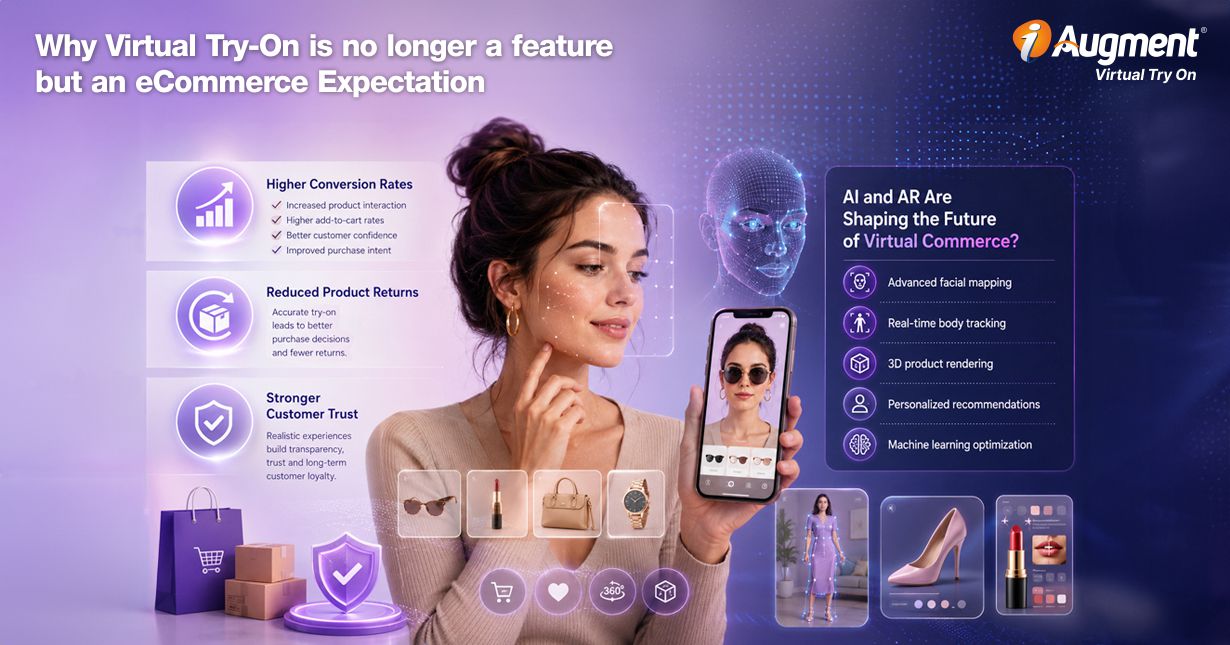
Higher Conversion Rates
One of the most significant benefits of virtual try-on technology is its ability to improve online sales conversions.
When customers can visualize products on themselves, they feel more certain about their choices. This confidence often results in faster purchasing decisions and reduced cart abandonment.
Brands implementing virtual try-on in online shopping frequently report:
- Increased product interaction
- Higher add-to-cart rates
- Better customer confidence
- Improved purchase intent
For modern eCommerce businesses, improving buyer confidence is directly connected to revenue growth.

Reduced Product Returns
Product returns remain a major challenge for online retailers, especially in industries like fashion, beauty, and accessories.
Many returns happen because products fail to meet customer expectations after delivery. Virtual try-on technology helps reduce this issue by improving product visualization accuracy before purchase.
Understand how visual commerce as a conversion optimization strategy.
Customers gain a better understanding of:
- Product fit
- Color compatibility
- Style appearance
- Proportions and sizing
This alignment between expectation and reality helps lower return rates and improve overall customer satisfaction.

Stronger Customer Trust
Trust plays a major role in online purchasing decisions. Customers are more likely to buy from brands that provide transparency and realistic product experiences.
Virtual try-on solutions create a sense of authenticity because shoppers can interact with products instead of relying solely on edited product images.
This transparency strengthens:
- Brand credibility
- Customer trust
- Purchase confidence
- Long-term loyalty
As immersive commerce continues to grow, trust-driven experiences will become even more important for eCommerce success.
Visual commerce for SMEs: Turning browsers into buyers.
Industries Where Virtual Try-On Is Already Expected

Jewelry eCommerce
Virtual try-on for jewelry has become increasingly popular because customers want to visualize how rings, earrings, necklaces, and bracelets look before purchasing.
Jewelry is highly personal and appearance-driven. Real-time product visualization helps customers feel emotionally connected to products, which often increases conversions.
Many jewelry brands now use AR jewelry try-on experiences to improve customer confidence and reduce purchase hesitation.

Watch eCommerce
The watch industry is also witnessing a major shift toward immersive shopping experiences. Since watches are both functional accessories and style statements, customers often want to see how a watch looks on their wrist before making a purchase.
Virtual try-on for watches allows shoppers to visualize:
- Dial size and proportions
- Strap styles and colors
- Metal finishes
- Wrist fit and appearance
- Styling compatibility with outfits
The real-time visualization helps customers make more confident buying decisions, especially for premium and luxury watches where appearance plays a significant role in purchase intent.
Learn the cost and benefits analysis of 3D models over traditional photography.
Many watch brands are now integrating AR-powered watch try-on experiences into their eCommerce platforms to create more engaging and personalized shopping journeys. These interactive experiences not only improve customer confidence but also help reduce hesitation associated with online accessory purchases.
As consumers increasingly expect interactive product visualization, virtual try-on technology is becoming an essential feature in modern watch eCommerce experiences.
The Psychology Behind Virtual Try-On Adoption
The success of virtual try-on technology is deeply connected to consumer psychology.
When customers visualize products on themselves, they begin developing a sense of ownership before purchase. This phenomenon, often referred to as the “endowment effect,” increases emotional attachment and purchase intent.
Virtual try-on also reduces cognitive uncertainty by helping users answer appearance-related questions instantly.
This combination of emotional engagement and practical reassurance makes interactive shopping experiences far more persuasive than traditional product pages.
In many ways, virtual try-on bridges the gap between physical retail confidence and digtial convenience.
Discover how to integrate virtual try-on with eCommerce platform.
How AI and AR Are Shaping the Future of Virtual Commerce?
The future of eCommerce is becoming increasingly immersive.
AI-powered virtual try-on systems are evolving rapidly through:
- Advanced facial mapping
- Real-time body tracking
- 3D product rendering
- Personalized recommendations
- Machine learning optimization
Brand investing early in immersive shopping technology are positioning themselves for long-term competitive advantage.
What Happens When Brands Ignore Virtual Try-On?
Brands that avoid interactive shopping technologies risk falling behind customer expectations.
Without virtual try-on capabilities, businesses may experience:
- Lower engagement rates
- Higher bounce rates
- Reduced conversion rates
- Increased product returns
- Poor mobile shopping experiences
- Reduced customer trust
Consumers increasingly compare online shopping experiences across industries. If one brand offers immersive visualization while another relies on static images, shoppers often perceive the interactive experience as more modern, trustworthy, and customer-focused.
This shift makes virtual try-on more than a marketing feature. It has become part of the expected digital shopping experience.
Understand how virtual try-on strengthen purchase decision.
Key Features Customers Expect from Virtual Try-On Solutions
Modern consumers expect virtual try-on system to be fast, accurate and seamless.
Important features include:
- Real-time rendering
- Mobile optimization
- AI-powered face and body mapping
- Accurate product positioning
- Fast-loading performance
- Multi-product comparison
- Cross-device compatibility
- Social sharing functionality
- Privacy-focused camera access
A poorly optimized virtual try-on experience can negatively affect trust and usability. Accuracy and performance are critical for long-term adoption.
Virtual Try-On and the Rise of Phygital Commerce
The line between physical and digital shopping is rapidly disappearing.
Modern retail experiences increasingly combine:
- Online discovery
- Interactive visualization
- In-store engagement
- Mobile personalization
- AI-driven recommendations
This connected ecosystem is often referred to as phygital commerce. Virtual try-on technology plays a major role in this transformation by helping brands create unified shopping experiences across digital and physical channels.
Find out how virtual try-on enhances product discovery and increase average order value.
From QR-based product experiences to in-store smart mirrors, immersive commerce is reshaping customer expectations across the retail industry.
The Future of eCommerce Is Interactive
The future of online shopping will not be built around static product pages alone. It will revolve around interactive, intelligent, and personalized experiences.
Consumers increasingly expect:
- AI shopping assistance
- Real-time visualization
- Personalized recommendations
- Immersive product exploration
- Digital confidence before purchase
Virtual try-on technology sits at the center of this evolution.
What was once considered an innovative feature is now becoming a standard expectation for modern eCommerce brands. Businesses that embrace interactive commerce today will be better positioned to meet future customer demands and remain competitive in a rapidly changing digital marketplace.
Learn how to transform your fashion brand with digital fashion showroom.
Conclusion
Virtual try-on is no longer a luxury feature reserved for large brands or experimental retail strategies. It has become a core expectation in modern eCommerce.
Customers now want more than product images. They expect immersive experiences that help them visualize products, reduce uncertainty, and shop with confidence.
From improving conversions and reducing returns to increasing engagement and strengthening customer trust, virtual try-on technology delivers measurable value across the entire customer journey.
As AI-powered commerce, augmented reality shopping, and phygital retail continue to evolve, brands that prioritize interactive shopping experiences will gain a significant competitive advantage.
The future of eCommerce belongs to businesses that make online shopping feel more personal, visual, and human.
Frequently Asked Questions
Q. What is Virtual try-on eCommerce?
Virtual try-on in eCommerce is a technology that allows customers to digitally visualize products on themselves using augmented reality, AI, and smartphone cameras before making a purchase.
Q. How does virtual try-on improve online shopping?
Virtual try-on improves online shopping by increasing customer confidence, reducing purchase hesitation, improving product visualization, and creating more interactive shopping experiences.
Q. Does virtual try-on increase conversion rates?
Yes. Virtual try-on technology often increases conversion rates because customers can better understand how products will look before purchasing.
Q. Which industries benefits most from virtual try-on?
Industries such as jewelry, beauty, eyewear, fashion, footwear, and accessories benefit significantly from virtual try-on technology because buying decisions are highly visual.
Q. Why is virtual try-on becoming an eCommerce expectation?
Consumers increasingly expect personalized and interactive shopping experiences. Virtual try-on helps brands meet these expectations by improving convenience, confidence, and engagement during the online shopping journey.