Introduction
Running successful virtual try-on jewelry or watch eCommerce stores is not easy. You invest heavily in inventory, photography, marketing, fulfillment, and customer acquisition. Then a customer places an order, receives the product, and decides to send it back.
The sales disappears. The shopping costs remain. Your profit margin shrinks. For jewelry and watch retailers, product returns are more than a minor inconvenience. They are one of the biggest threats to sustainable growth.
Many returns happen because customers struggle to visualize how a product will actually look on them before purchasing. A ring may appear larger online. A watch may look different on the wrist. A necklace may not complement the customer’s style the way they expected.
This is where virtual try-on technology changes the game.
Modern augmented reality solutions allow shoppers to see products on themselves before purchasing. The result is greater confidence, fewer surprises, higher conversion rates, and significantly lower return rates.
If your return numbers are hurting profitability, virtual try on may be the technology upgrade that your business needs.
The Hidden Cost: Why High return Rates Break eCommerce Business Models
Returns are expensive as not only the product is returned, but you also have to bear the entire logistics and handling costs. Most business owners focus on immediate loss of sales. The reality is far more complex.
Every returned luxury item creates multiple layers of cost that directly impact profitability with virtual try-on.

1. Reverse Logistics Expenses
When a customer sends back a product, the journey is repeated in reverse.
You pay for:
- Return shipping
- Handling fees
- Processing costs
- Inspection labor
- Packaging replacement
These expenses accumulate quickly, especially for premium products.

2. Shipping Insurance Costs
Jewelry and luxury watches often require specialized shipping protection. Because of their value, many orders require:
- Signature confirmation
- Insurance coverage
- Secure packaging
- Enhanced tracking
When products are returned, many of these costs occur twice.

3. Restocking vulnerabilities
Unlike everyday retail products, luxury items face additional challenges after being returned. Returned jewelry may show signs of wear. Luxury watches may require detailed inspection. Packaging may be damaged. Certificates of authentication materials may be missing.
Some products can no longer be sold as new, reducing their value and forcing discounts.

4. Customer Acquisition Costs Remain
Perhaps the most overlooked cost is marketing spend. You already paid to acquire that customer. If the purchase is reversed, your advertising investment remains while the revenue disappears.
For many jewelry and watch brands, high return rates quietly erode profitability even when sales appear strong on the surface.
The Core Drivers Behind Luxury Product Returns
Understanding why customers return products in the first step toward solving the problem.
The Fit Dilemma
One of the most common reasons for returns is uncertainty around fit.
Customers often struggle to answer questions such as:
- Will this ring fit comfortably?
- Is the watch case too large?
- Will the bracelet look bulky?
- Does the necklaces sit at the desired length?
Product specifications alone cannot always communicate real-world proportions. Even when measurements are provided, many shoppers find it difficult to visualize dimensions on their own body.
The result is guesswork. Guesswork frequently leads to returns.
The Visual Disconnect
Professional product photography is important. However, studio images cannot replicate every real-world scenario. Lighting conditions differ. Skin tones vary. Body proportions change from customer to customer.
A ring photographed under controlled lighting may look different when worn in everyday situations. watch may appear elegant in a product image but feel oversized once it arrives. This gap between expectation and reality often triggers disappointment.
The Trust Gap
Luxury purchases involve emotion. Customers are not simply buying a product. They are buying confidence, identify, and personal expression. When shoppers cannot visualize a high-value item on themselves, hesitation increases.
Questions arise:
- Will this look good on me?
- Is this worth the price?
- Am I making the right choice?
Without visual confirmation, uncertainty becomes a major barrier to purchase confidence.
The Information Deficit
Even detailed product pages face challenges. Many shoppers skim content. Some overlook important specifications entirely. Other struggle to interpret technical details.
Information such as:
- Stone dimensions
- Metal thickness
- Watch lug width
- Case diameter
- Strap proportions
- Certifications
- What’s inside the box
May be available but not fully understood.
Customers often discover these details only after delivery, which increases the likelihood of returns
Reduce returns and boost buyer confidence with Virtual Try-On
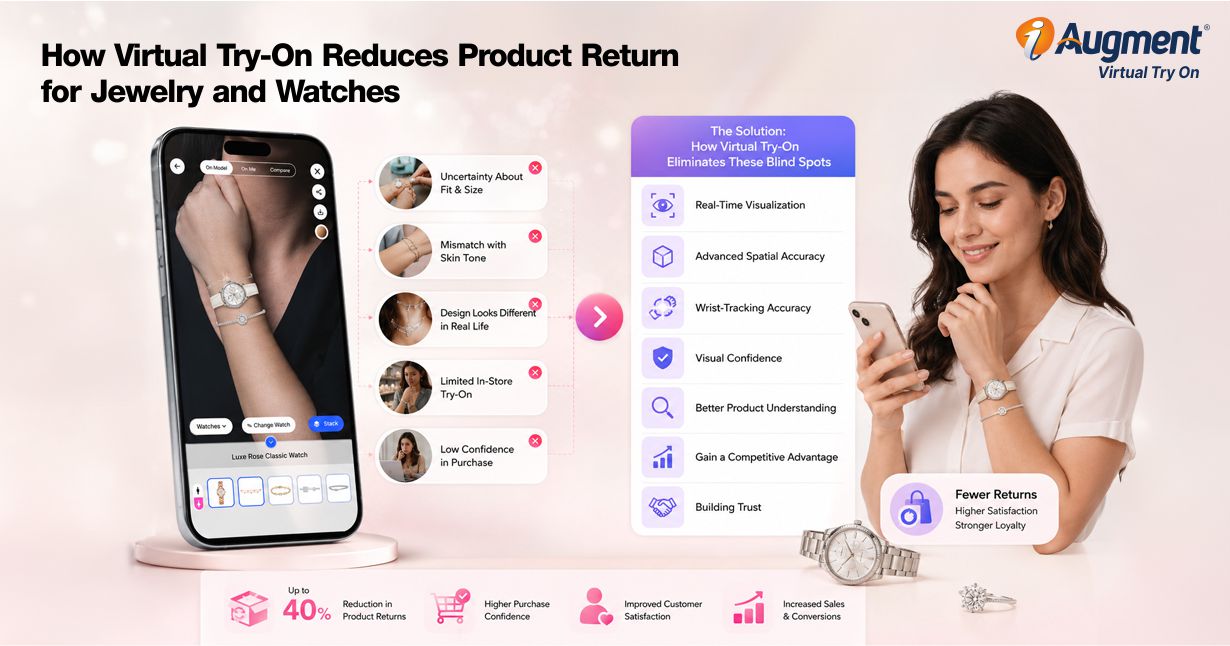
The Solution: How Virtual Try-On Eliminates These Blind Spots
Virtual try-on technology directly addresses the root causes of product returns. Instead of asking customers to imagine how a product will look, technology shows them.

1. Real-Time Visualization
Using smartphones cameras and augmented reality, shoppers can instantly view products on themselves. Rings appear on the fingers. Necklaces appear around the neck. Watches appear on the wrist.
Customers gain a realistic preview before purchasing. This reduces uncertainty and creates stronger buying confidence.

2. Advanced Spatial Accuracy
Modern systems use sophisticated AR scaling techniques to represent product dimensions more accurately.
Spatial accuracy helps customers understand:
- Relative size
- Product proportions
- Placement on the body
- Overall appearance
The closer the digital representation matches reality, the lower the likelihood of dissatisfaction after delivery.

3. Wrist-Tracking Accuracy
For watch retailers, wrist tracking is particularly valuable. Advanced solutions continuously track wrist movement and orientation in real time. This allows customers to see how watches look from multiple angles.
A high-quality AR watch virtual try-on software platform can simulate watch placement with remarkable realism, helping customers evaluate size, design, and style before making a purchase.

4. Visual Confidence
With virtual try-on, when customers see products on themselves before purchasing, they make more informed decisions. Instead of wondering whether a ring complements their style, they already know.
Instead of guessing whether a watch feels oversized, they have already visualized it. This increased confidence naturally reduces return requests.

5. Better Product Understanding
Virtual try-on serves as an interactive product education tool.
Customers learn more about:
- Scale
- Shape
- Design details
- Proportions
- Styling compatibility
Without reading lengthy descriptions. This helps bridge the information gap that often contributes to returns.

6. Gain a Competitive Advantage
Retailers using augmented reality jewelry try-on solutions frequently report stronger engagement metrics because shoppers spend more time interacting with products.
More engagement often translates into:
- Higher conversion rates
- Lower return rates
- Greater customer satisfaction
- Increased repeat purchases
The shopping experience becomes more immersive and persuasive.

7. Building Trust
Virtual try-on technology creates transparency. Customers see exactly what they are considering purchasing. That transparency strengthens trust and reduces the risk of buyer’s remorse.
An effective augmented reality jewelry try-on experience helps transform uncertainty into confidence before checkout. Similarly, premium AR watch try-on software gives shoppers the reassurance needed to purchase luxury watches online without hesitation.
Next-Gen Commerce: What is the Future of Virtual Retail?
Virtual try-on technology continues to evolve rapidly. The next generation of virtual retail will be even more advanced, realistic, and intelligent.
1. Hyper-Realistic Material Rendering
Future AR systems are becoming increasingly sophisticated at rendering luxury materials.
This includes:
- Diamond brilliance
- Gemstone reflections
- Precious metal finishes
- Polished watch cases
Advanced rendering engines can simulate how diamonds catch and reflect light under different viewing conditions. This creates a more authentic shopping experience.
2. AI Style Assistants
Artificial intelligence is beginning to work alongside AR experiences.
Future shopping assistants may recommend:
- Complementary jewelry pieces
- Matching watch styles
- Personalized collections
- Occasion-based suggestions
These recommendations can help customers discover products that align with their preferences.
3. Enhanced Personalization
Future systems may combine:
- Purchase history
- Style Preferences
- Facial analysis
- Wrist measurements
- Fashion trends
To deliver highly relevant recommendations.
4. Cross-Device shopping Experiences
Virtual retail experiences will become increasingly seamless across:
- Smartphones
- Tablets
- Desktop computers
- Smart glasses
- Wearable devices
Customers will moe effortlessly between devices while maintaining a consistent shopping journey.
5. Digital Confidence
Consumers increasingly expect interactive shopping experiences. What feels innovative today may soon become a standard requirement for luxury eCommerce brands.
Businesses that adopt these technologies early position themselves ahead of competitors while creating stronger customer relationships.
Conclusion
If you sell jewelry or watches online, return rates deserve constant attention. Every return impact revenue, operational efficiency, and customer acquisition profitability. Most returns originate from uncertainty.
Customers cannot accurately judge fit, size, appearance, or style compatibility from static images alone.Virtual try-on technology solve these problem by replacing guesswork with visual confidence.
When shoppers can see products on themselves before purchasing, they make better decisions.
That leads to:
- Fewer returns
- Higher conversions
- Stronger trust
- Better customer experiences
- Improved profitability
Now is a good time to audit your current return rates and identify the biggest causes behind them. If visual uncertainty is driving returns, upgrading your eCommerce technology stack with virtual try-on capabilities may be one fo the highest-impact investments you can make.
Frequently Asked Questions
Q. Does virtual try-on technology actually reduce jewelry return rates?
Yes. Virtual try-on helps customers visualize products before purchasing, reducing uncertainty about appearance, size, and style. Better purchase confidence often leads to fewer returns.
Q. How accurate id AR watch virtual try-on technology?
Modern solutions use advanced wrist tracking and AR scaling to create realistic watch placement. Accuracy varies by platform, but leading systems provide highly reliable visual representations.
Q. Can virtual try-on increase jewelry sales?
Yes. Virtual try-on improves shopper confidence, increases product engagement, and reduces hesitation during the buying process, which can positively impact conversion rates.
Q. Is virtual try-on technology suitable for luxury jewelry brands?
Absolutely. Luxury shoppers often want more confidence before making high-value purchases. Virtual try-on provides a realistic visualization experience that supports trust and informed decision-making.
Q. Why do jewelry customers return products purchased online?
Most jewelry returns happen because customers are unsure about size, fit, appearance, or how the product looks on them in real life. Virtual try-on technology helps reduce this uncertainty by allowing shoppers to visualize products before purchasing.