Introduction
Luxury shoppers expect more than polished product photos. They want confidence before they spend hundreds or thousands of dollars online. That is where AR-powered virtual try-on enters the conversation.
But for executives, the question is not whether the technology looks impressive. The real question is whether it delivers measurable business value. Can it increase revenue, reduce returns, and improve customer acquisition efficiency?
If you are evaluating AR for your jewelry or watch business, the answer lies in the numbers. This guide explains the metrics that matter and how to measure the true return on your investment.
Know the challenges of virtual try-on implementation.
Why Virtual Try-On Moves the Needle
Luxury ecommerce has changed dramatically over the last few years. Static product galleries no longer satisfy buyers who expect interactive shopping experiences similar to those found in physical boutiques.
Today’s customers want to visualize how a diamond ring looks on their hand. They want to see whether a bracelet complements their skin tone. They want to compare different augmented reality watches before making a purchase.
This shift has transformed AR for ecommerce from an experimental feature into a competitive advantage.
Several market trends are driving this change:
- Online luxury shopping continues to grow.
- Mobile commerce dominates product discovery.
- Younger buyers expect interactive digital experiences.
- Competition makes differentiation increasingly difficult.
Virtual experiences reduce one of the biggest barriers to online luxury purchases, uncertainty. Instead of imagining how a product might look, shoppers can see it on themselves in real time. That confidence often becomes the difference between browsing and buying.
Understand why virtual try-on is an eCommerce expectation.
For brands researching how to increase jewelry conversion rates with AR, virtual try-on has become one of the most practical investments because it directly addresses purchase hesitation while creating a memorable customer experience.
Turn Product Browsing into Confident Buying
Why Measuring Virtual Try-On ROI Matters
Every technology investment competes for budget. As a business leader, you need more than impressive demos. You need measurable financial outcomes.
That means asking questions like:
- Does virtual try-on increase revenue?
- Does it reduce customer acquisition costs?
- Does it lower product returns?
- Does it improve customer lifetime value?
These answers determine whether an investment deserves expansion across your ecommerce ecosystem. A successful virtual jewellery try-on solution should never be measured solely by engagement metrics.
Instead, evaluate its contribution across your entire sales funnel. From first interaction to completed purchase and repeat orders, every stage should demonstrate measurable improvement.
When executives evaluate the ROI of virtual try-on for luxury retail, the strongest business cases connect customer experience improvements directly to financial performance.
Key Metrics That Prove the Financial Impact

1. Conversion Rate Lift
One of the clearest indicators of success is conversion rate. Luxury purchases involve significant consideration. Customers often hesitate because they cannot visualize size, fit, or appearance.
This is where jewelry try-on AI creates measurable value. By allowing shoppers to preview products realistically, virtual try-on removes uncertainty before checkout. Instead of relying on imagination, buyers experience the product digitally.
The result is greater purchase confidence. Brands frequently observe higher completed purchases, fewer abandoned product pages, better mobile conversions, and faster buying decisions.
For companies exploring how to increase jewelry conversion rates with AR, conversion lift should be one of the first KPIs tracked before and after deployment.

2. Customer Acquisition Cost (CAC) Efficiency
Advertising costs continue to rise. Improving acquisition efficiency has become just as important as increasing sales. Interactive campaigns featuring AR experiences typically generate stronger engagement than traditional static advertisements.
Potential customers spend more time exploring products. They are more likely to click, interact, and continue toward purchase.
This often produces better click-through rates, improved landing page engagement, higher conversion from paid traffic, and lower effective customer acquisition cost. Instead of paying more for every customer, brands improve the productivity of existing advertising budgets.
Learn how virtual try-on reduces product return for jewelry and watches.

3. Engagement and Interaction Rate
Luxury purchases are emotional decisions. The more time customers spend exploring products, the stronger their purchase intent often becomes.
Virtual try-on increases meaningful engagement because shoppers actively interact with products rather than passively viewing images.
Track metrics such as session duration, number of products tried, repeat visits, feature usage rate, and product comparison activity. Higher engagement often correlates with stronger brand recall and improved customer loyalty.
Rather than simply browsing, customers begin experiencing your products.

4. Add-to-Cart Rates
Adding products to the cart represents a critical milestone. Many customers hesitate immediately before this stage because they remain uncertain about appearance or suitability. Virtual try-on reduces that hesitation.
Customers who have already visualized the product often feel significantly more confident moving forward. This can lead to higher add-to-cart percentages, reduced abandonment before checkout, and more completed purchase journeys.
For luxury brands, even modest improvements in this metric can generate substantial incremental revenue.

5. Return Reduction Rate
Returns represent one of ecommerce’s largest hidden expenses. Shipping, inspection, restocking, customer service, inventory delays, all of these reduce profitability.
Many luxury returns happen because products simply did not match customer expectations. A realistic AR experience helps set accurate expectations before purchase.
Customers understand scale, fit, appearance, and style compatibility. That clarity reduces buyer remorse.
Among all metrics used to calculate the ROI of virtual try-on for luxury retail, lower return rates often deliver some of the fastest financial gains because they directly reduce operational costs.
Find out how stacking increases the average order value for jewelry brands.

6. Average Order Value (AOV)
Confidence influences spending. When customers feel certain about a purchase, they become more willing to consider premium options. Virtual try-on supports upselling by allowing shoppers to compare multiple products instantly.
Examples include larger gemstones, premium finishes, matching jewelry sets, luxury watch collections, and higher-value product variants.
Instead of wondering whether an upgrade is worthwhile, customers can see the difference immediately. That visual confidence frequently increases average order value.

7. Customer Confidence and Post-Purchase Feedback
Strong customer experiences extend beyond checkout. Satisfied customers are more likely to leave positive reviews, share purchases on social media, recommend your brand, purchase again, and join loyalty programs.
Positive reviews also strengthen trust for future buyers. Over time, this creates a compounding effect.
Better experiences generate a stronger reputation. A stronger reputation attracts higher-quality customers. Higher-quality customers improve long-term profitability.
That is why customer satisfaction should remain part of every executive ROI dashboard.
Transform Your Jewelry Store into an Interactive Experience
Common Mistakes Brands Make When Deploying AR
Not every implementation succeeds. Technology alone does not guarantee results. Common mistakes include:
- Poor Product Accuracy:If sizing, proportions, or positioning appear unrealistic, customers lose confidence quickly. Accuracy matters more than visual effects.
- Slow Loading Experiences:Luxury shoppers expect speed. If virtual try-on takes too long to load, abandonment rates increase. Performance optimization should remain a priority.
- Limited Device Compatibility:Customers shop across smartphones, tablets, and desktops. A solution that performs well only on selected devices limits overall adoption.
- Weak User Experience:Complicated instructions discourage engagement. The best experiences require only a few simple steps before customers begin trying products.
- Missing Analytics:Many brands launch virtual try-on without defining KPIs. Without proper tracking, leadership cannot connect customer interactions to revenue outcomes. Monitor metrics including feature adoption, conversion rate, return rate, average order value, and revenue influenced by AR sessions. These data should guide future investment decisions.
Discover the guide for virtual try-on for watches.
The Future of Business ROI in AR
Virtual commerce continues to evolve rapidly. Artificial intelligence now improves product placement, personalization, and visual accuracy.
Future innovations are expected to include smarter jewelry try-on AI personalization, multi-product styling recommendations, AI-assisted luxury shopping advisors, more realistic, augmented reality watches experiences, cross-device shopping continuity, and personalized product recommendations based on virtual try-on behavior.
As these technologies mature, virtual shopping will become increasingly integrated into everyday ecommerce. Brands adopting immersive experiences today will be better positioned to compete as customer expectations continue to rise.
Conclusion
Virtual try-on is no longer simply a visual enhancement. It is a measurable business investment.
When implemented thoughtfully, it can increase conversions, improve customer confidence, reduce costly returns, raise average order value, and strengthen long-term customer relationships.
The difference lies in choosing technology that prioritizes accuracy, speed, usability, and measurable analytics. If your customers already expect interactive shopping experiences, delaying adoption may become more expensive than the investment itself.
For luxury jewelry and watch brands, AR for ecommerce has become a practical tool for improving business performance while delivering the confidence shoppers need before making high-value purchases.
Frequently Asked Questions
Q. Are virtual watch try-on features available for all watch brands? +
Most watch brands can implement virtual try-on if they have quality product imagery or compatible digital assets.
Modern platforms support a wide range of collections without requiring every product to be recreated as a detailed 3D model, making adoption practical for both established luxury brands and growing retailers.
Q. How does virtual watch try-on technology work for watches? +
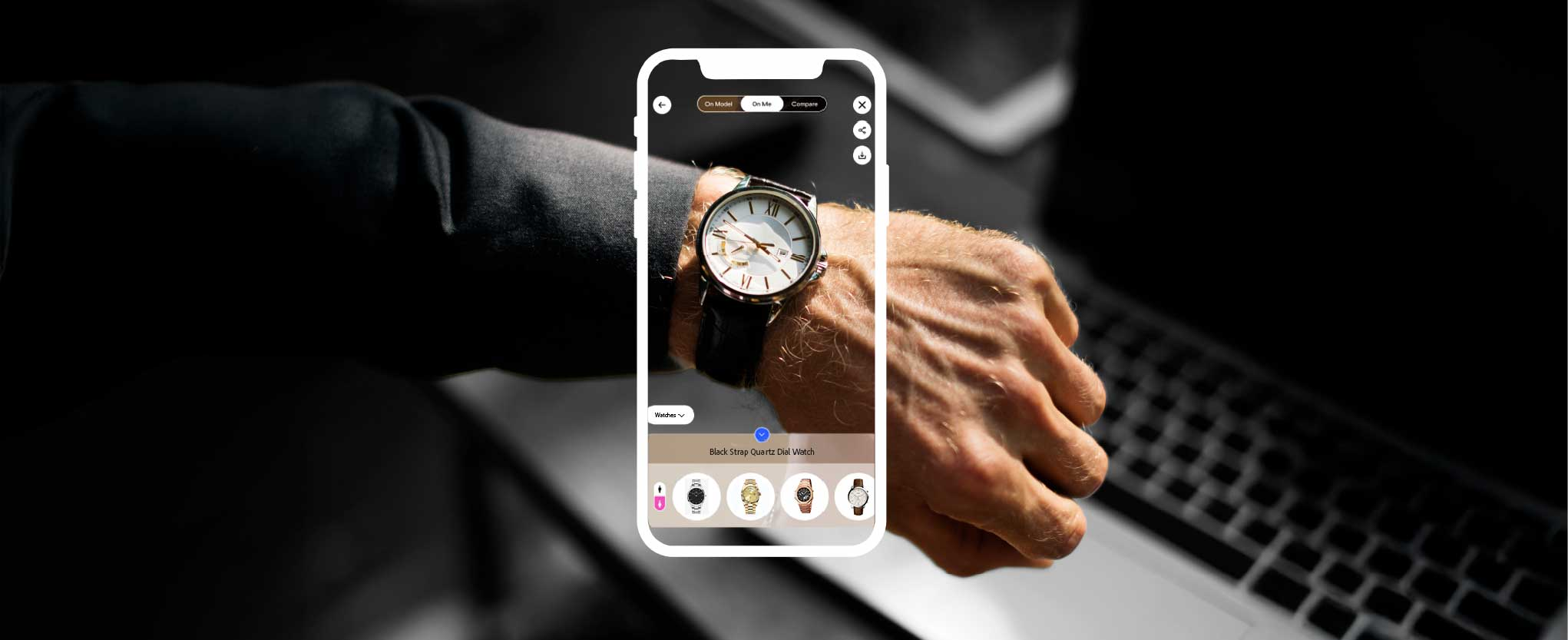
Virtual watch try-on uses your device's camera along with computer vision and augmented reality to detect the user's wrist.
The software places a digital version of the watch onto the live camera view and adjusts its position and scale in real time, so shoppers can evaluate fit and appearance before purchasing.
Q. What is the average conversion lift after adding jewelry try-on AI? +
Results vary by product category, customer base, and implementation quality. Many jewelry retailers report meaningful improvements in engagement and conversion because shoppers gain greater confidence before purchasing.
The biggest gains typically come when virtual try-on is accurate, easy to use, and integrated naturally into the buying journey.
Q. How does AR for ecommerce lower return rates for luxury items? +
AR experiences allow customers to preview how jewelry or watches will look before completing a purchase. By reducing uncertainty around appearance, size, and style, shoppers make more informed decisions.
This can help reduce returns caused by unmet expectations or buyer hesitation, particularly for premium and luxury products.
Q. Is it difficult to integrate a virtual jewellery try-on tool into an existing Shopify or custom store? +
Most modern virtual try-on platforms integrate with Shopify, Magento, and custom ecommerce websites using APIs or lightweight app integrations.
Deployment complexity depends on the provider, but many AI-powered solutions can be implemented without requiring every product to have a full 3D model. This allows brands to launch faster while minimizing development effort.